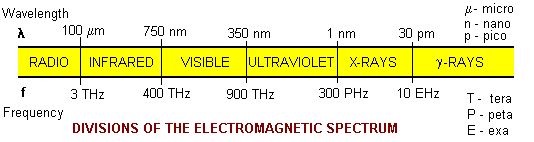
Figure 1 The electromagnetic spectrum and its major divisions - note that the frequency is not linear but has been drawn to show the major divisions of the EM spectrum.
ABSTRACT
There are now three astronomical messengers known which bring us information about the Universe. These are electromagnetism, cosmic particles and gravitational waves. This paper presents a brief overview of these three messengers.
INTRODUCTION
A messenger is something or someone that carries a message. Astronomy is the study of the universe via messages carried from space to the observer on Earth. For most of our history those messages have been carried to us via electromagnetic energy, and in particular the electromagnetic energy we known as visible light. However, in the 20th century our view of the universe expanded tremendously when we learnt how to make use of other parts of the electromagnetic spectrum. We now have astronomies that make use of all the known parts of the electromagnetic (EM) spectrum (figure 1).
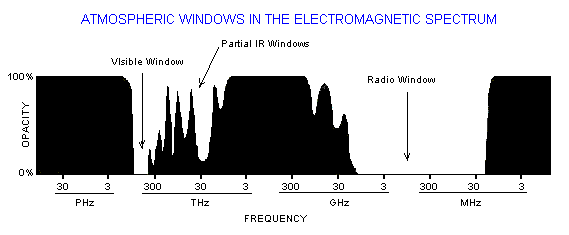
Not all EM energy can pass through the Earth's atmosphere as both the neutral and ionised portions of the upper atmosphere absorb a large portion of the EM spectrum (figure 2). In fact, only the radio, infrared and visible parts of the spectrum have large 'windows' through which the universe is visible.
However, the EM spectrum is not the only way we can now view the universe. Around the end of the first decade of the 20th century it was discovered that particles of matter created by processes in the galaxy were reaching the Earth and an entirely different type of messenger provided a second window to space. These were termed 'cosmic rays', but in fact were not rays in the usual sense. The discipline of particle astronomy was created.
And then in 2015, an entirely different and third messenger was detected. This messenger, termed 'gravitational waves' was predicted by Albert Einstein in 1915, but the magnitude of these waves is so incredibly small that it took 100 years to develop the incredible technology to the point where it was sensitive enough to detect these waves from the most powerful processes in the Universe at distances of many mega-parsecs ( 1 parsec = 3.26 light years ).
2 Multi-Messenger Astronomy
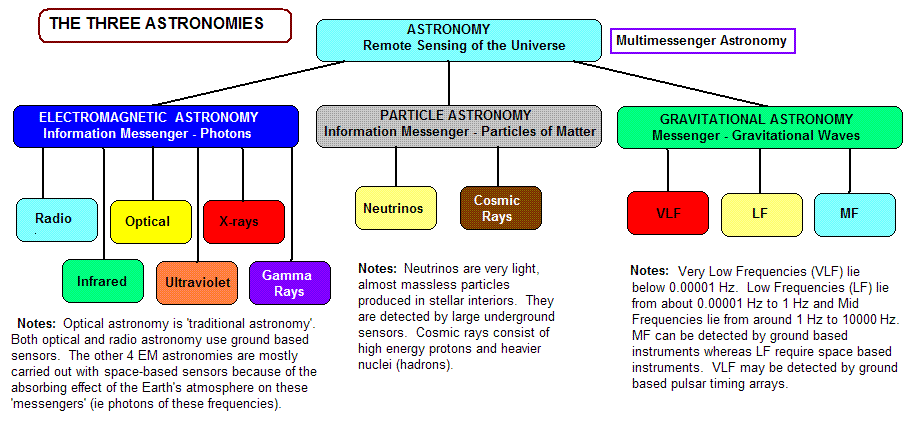
Figure 3 summarises the three astronomies as we understand them today.
3 Electromagnetic Astronomy
Ever since Galileo turned his telescope toward the heavens optical astronomy has continued to reveal more and more aspects of the universe in the visible part of the EM spectrum. Ground based telescopes are limited by the atmosphere to a resolution of around one second of arc (1"). Although this is only 30 times better than the best angular resolution of the unaided human eye (which is ~30") , increasing telescope apertures capture increasingly more light making more distant objects visible. Moving the telescope into space will of course allow increased resolution with aperture. Adaptive optics also allows atmospheric turbulence to be removed from ground based telescopes increasing their resolution below the one arc-second uncorrected limit.
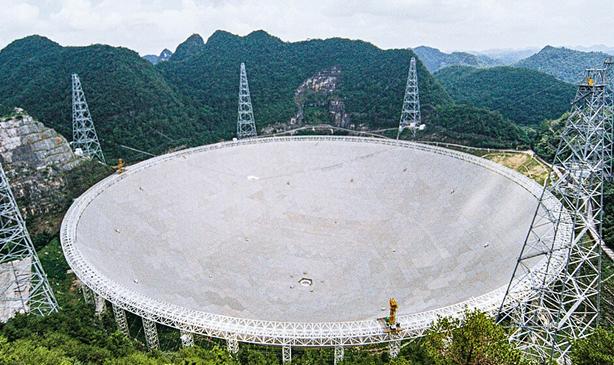
The beginning of radio astronomy is often regarded as the detection of radio waves from the Milky Way in the year 1932 by physicist/engineer Karl Jansky. The largest single dish radio telescope is the 500m diameter FAST (Five hundred meter Aperture Spherical Telescope) in Pintang County in south-western China (figure 4). At the hydrogen line wavelength of 21 cm this telescope has an angular resolution of 90" which is 3 times worse than the human eye. However, radio telescopes can be linked together in interferometric arrays to give a much greater resolution than any single mirror optical telescope.
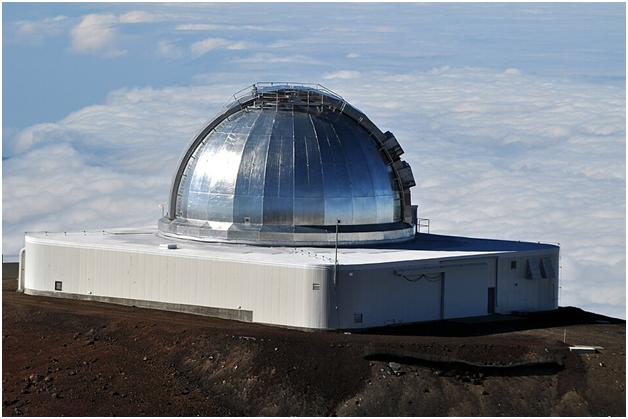
Infrared telescopes are either placed on top of high mountains (figure 5) or in space . The James-Webb infrared telescope, with a diameter of 6.5m is the largest telescope in space. It has an infrared shield to reduce the IR radiation of the Sun as much as possible and is located in a halo orbit around Sun-Earth L2 Lagrange point. Its wavelength range of operation is from 0.6 to 28 μm.
Telescopes detecting short-wavelength ultraviolet, x-ray and gamma radiation will only work in space above the Earth's atmosphere. The Chandra X-ray Observatory is currently the world's most powerful X-ray telescope, and it is in an elliptical Earth orbit with a perigee of 16,000 km and apogee of 133,000 km.
The most sensitive gamma ray telescope in space is the Fermi Gamma-ray Space Telescope. It is a joint venture between the USA, France, Germany, Italy, Japan and Sweden. It is in a nearly circular orbit just above 500km altitude with an inclination of 25 degrees. It includes two telescopes, the LAT that can image over the energy range from 20 MeV to 300 GeV, and the GBM that can detect gamma-ray bursts in the 8 keV to 1 MeV range and the 150keV to 30 MeV range.
4 Particle Astronomy
Particle astronomy is generally divided into two branches: cosmic ray astronomy and neutrino astronomy.
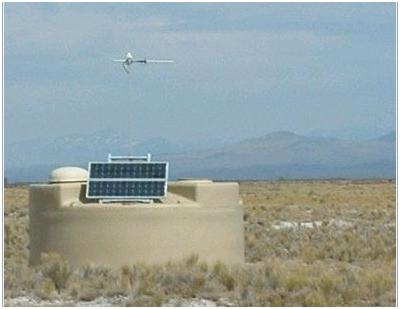
Cosmic ray astronomy uses very high speed (near light velocity) charged particles as its messengers of information transfer. It began with the discovery of cosmic rays by Victor Hess in 1912, using a balloon borne detector. The majority of cosmic rays studied are high energy protons but also include muons, electrons and positrons as well as nuclei from heavier elements (mostly alpha particles). Cosmic ray telescopes can be either ground based, balloon borne or satellite based. The largest cosmic ray observatory is the Pierre Auger Observatory spread over an area of 3,000 square kilometres in Argentina (figure 6). Space based cosmic ray detectors detect primary cosmic rays , whereas ground based detectors detect secondary particles produced by interactions of the primary particles with molecules in the Earth's atmosphere.
Originally cosmic ray observations led to the discovery of subatomic particles such as the positron and the muon and laid the ground work for modern particle physics. Further observations revealed the galactic and solar nature of cosmic rays, the presence or radiation belts around the earth and other planets and the presence of magnetic fields and radiation throughout the galaxy. Ground detectors now measure the properties of the 'air shower'; the cascade of secondary particles that result from the primary particle interaction with primarily nitrogen molecules in the atmosphere. In this way the direction and energy of the primary particles can be inferred.
Because cosmic rays are charged particles and because magnetic fields are ubiquitous throughout galaxy the original source position cannot be calculated. However, the general properties of the galactic field can be modelled. The intensity-energy diagram has also led us to believe that the highest energy cosmic rays probably come from outside the galaxy.
Neutrinos from the Sun were first detected by Ray Davis of the Brookhaven National Laboratory at an underground detector based in an old Gold Mine in South Dakota. Only a few neutrinos were detected (compared to the estimated detection rate) and it was initially thought that fusion in the solar core may have ceased. However, it was later realised that there are three types of neutrinos and that they oscillate between types as they travel (eg over the distance from the Earth to the Sun).
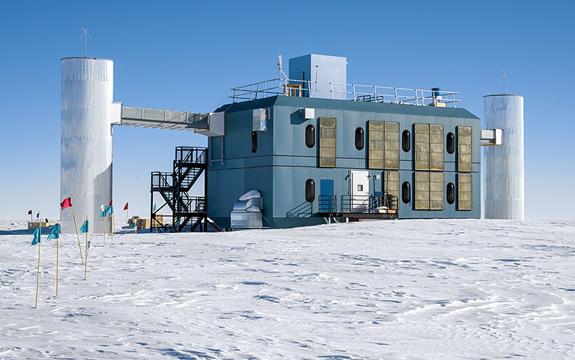
The largest neutrino detector currently operating is the IceCube neutrino observatory located at the geographic south pole under the ice (figure 7). It consists of over 5000 sensors located in a cubic kilometre volume situated between the depths of 1500 and 2500 metres. It can detect neutrinos coming both ways through the Earth (ie from the surface above and travelling through the Earth itself).
Because neutrinos are uncharged it is possible to trace the direction from which they have come and possibly identify the source. One of the promising results links neutrinos to bright active galaxies.
5 Gravitational Wave Astronomy
Albert Einstein's theory of General Relativity predicted the existence of gravitational waves (GW) in 1915. However, the amplitude of these waves was so small that Einstein doubted they would ever be detected.
The first indirect detection of gravitational waves was made by timing pulsars (EM emissions) in 1974 by Joseph Taylor and Russell Hulse for which they were awarded a Nobel Prize.
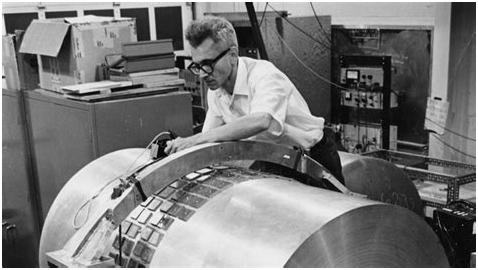
It was not until 1960 that the first attempt was made to directly detect these waves. That attempt was made by Joseph Weber of Maryland University using a very large aluminium bar (figure 8). Several further attempts were made using such resonant bar detectors with increasing sensitivity. Strains in the fabric of space-time would change the dimensions of the bar by a miniscule amounts. These changes would be detected by orthogonal strain gauges which would be electronically amplified to levels it was hoped could be detected.
No convincing detections were ever made by resonant bar antennas and attention was then turned to laser interferometer systems. Two such systems were built with four kilometre long orthogonal arms, one at Hanford, Washington State, USA and the other at Livingston, Louisiana, USA (figure 9). These were termed LIGO for Laser Interferometer Gravitational-Wave Observatory. The first observing runs proved negative. But following an upgrade in sensitivity the first GW was detected on 14 September 2015, 100 years following Einstein's prediction of their existence. Multimessenger Astronomy can truly be said to have come of age at this time with three astronomical messengers now known.
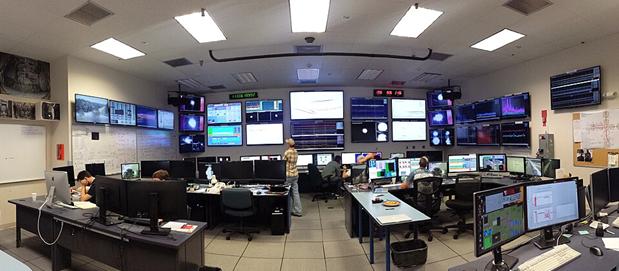
As of March 2025, 290 gravitational wave events have been confirmed. Most of these have been due to the merger of two black holes. A few have been due to binary neutron star mergers. The most common distance for detected mergers has been 2 to 5 gigaparsecs, and the most common total mass involved in the mergers has been in the 20 to 40 solar mass range.
6 Active Electromagnetic Astronomy
The astronomies discussed up to this point have all been passive astronomies. However for several decades we have had the technology to perform active sensing of the closest bodies of the solar system. This has been carried out from Earth and also from space. Radar reflections have been detected from the Moon, Mars and Venus with Earth-bound radar systems. The first of these was the Moon in 1946. Radar has also been used by spacecraft orbiting the planets.
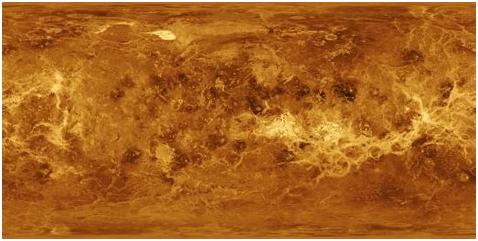
Probably the most productive use of radar astronomy was from spacecraft orbiting Venus. This is because Venus has such a dense atmosphere that no visible light from the surface escapes into space. However, a radar system on the Venus Magellan probe has completely mapped the surface of Venus (figure 10).
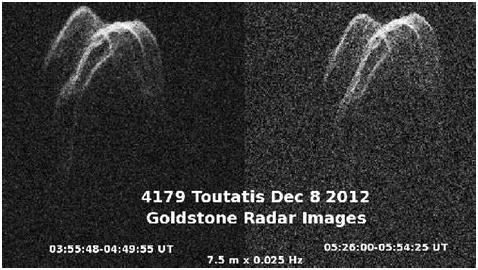
More recently radar images of Near Earth Asteroids (NEA) have and are being made using facilities of the NASA Deep Space Network in California, USA and Tidbinbilla in New South Wales, Australia (figure 11). Of particular importance is the ability of these measurements to obtain the rotation periods of asteroids that could pose a threat to the Earth in future years. Such knowledge is imperative if these asteroids are to be deflected from a potential Earth-impacting orbit.
Lidar ('radar' using visible or infrared light) is an active EM system that has been used in spacecraft orbiting the Moon, asteroids and some planets. Lidar carried by the NASA Lunar Reconnaissance Orbiter was particularly effective in mapping the south polar region of the Moon where solar lighting becomes particularly deficient for passive optical mapping, and where water ice is present.
7 Reading
1 Louis Bell, The Telescope, McGraw Hill 1922, Dover Edition 1981 , Alpha Edition 2023
2 John K Davies, Astronomy from Space - The Design and Operation of Orbiting Observatories, Wiley 1997
3 Bernard Burke & Francis Graham-Smith, An Introduction to Radio Astronomy, Cambridge University Press 1997
4 W N Christiansen & J A Hogbom, Radiotelescopes, Cambridge University Press 1969
5 John D Kraus, Radio Astronomy, Cygnus-Quasar Books 1982
6 A Richard Thompson, James M Moran & George W Swenson Jr, Interferometry and Synthesis in Radio Astronomy , Springer 2017
7 Peter Robertson, Beyond Southern Skies - Radio Astronomy and the Parkes Telescope, Cambridge University Press 1992
8 Riccardo Giacconi, Secrets of the Hoary Deep (X-ray Astronomy), John Hopkins University Press 2008
9 Bruno Rossi, Cosmic Rays, McGraw-Hill 1964
10 A W Wolfendale, Cosmic Rays, Newnes 1963
11 Michael W Friedlander, A Thin Cosmic Rain - Particles from Outer Space, Harvard University Press 2000
12 Roger Clay & Bruce Dawson, Cosmic Bullets: High Energy Particles in Astrophysics, Allen & Unwin 1997
13 Isaac Asimov, The Neutrino - Ghost Particle of the Atom, Dennis Dobson-London 1966
14 Steven J Dick, Discovery and Classification in Astronomy, Cambridge University Press 2013
15 David H Levy, Cosmic Discoveries, Prometheus Books 2001
 Australian Space Academy